Montar(se) la vida
I remember -I was very small- having seen a scene, in black and white, in which a dog walked down the street with one hand in its mouth.
That was my first contact with Akira Kurosawa’s Yojimbo (1961), and it was not special, it did not make me love cinema and much less did it provoke me to think that film editing would trace the paths of my history.
No. My overflowing taste for cinema does not begin in childhood as it happens to many; it begins in that almost mature youth in which one approaches his 20s. And that detail offers a guarantee that is not minuscule: the anguish of arriving late causes the frenzy during each analysis not to lose any detail.
Why do I remember with pertinacity that scene from Yojimbo? Because Enrique Colina, the director of the old Sunday TV program -24 x segundo- that used to show it, would be one of my professors during the Audiovisual Media Art course at the Higher Institute of Art (ISA) in Havana.
There I would discover the work of Santiago Alvarez, Nicolas Guillen Landrian, Bergman, Tarkovsky, Kieślowski, Zang Yimou, Kim Ki-duk, Godard, Antonioni, Fellini….
There I would move, back and forth, between the classroom and the programming of the Cinemateca de Cuba, the International Festival of New Latin American Cinema and José Rosado’s classes, every Saturday, at the school’s Faculty of Music.
There, when I chose editing as my specialty, I had, among my great teachers and friends, Nelson Rodriguez, the man who edited a classic like Memorias del subdesarrollo (Memories of Underdevelopment).
So, with so many films around, whether Greek, Romanian or Polish, there was no way that cinema -good cinema- would not cross my path, would not sneak in, would not anchor in my taste and in my soul.
My frantic eagerness for everything related to the seventh art found a new incentive when I began my life as an editor at the Cuban Institute of Art and Cinematographic Industry (ICAIC). That was the highest level of cinema in the country, the place where a simple newsreel could be turned into a creative documentary.
I was there for five years under the watchful eye of Miriam Talavera, the editor of the renowned Fresa y Chocolate, and I must say that I owe her three fundamental bases of my profession: professionalism, methodology and sensitivity.
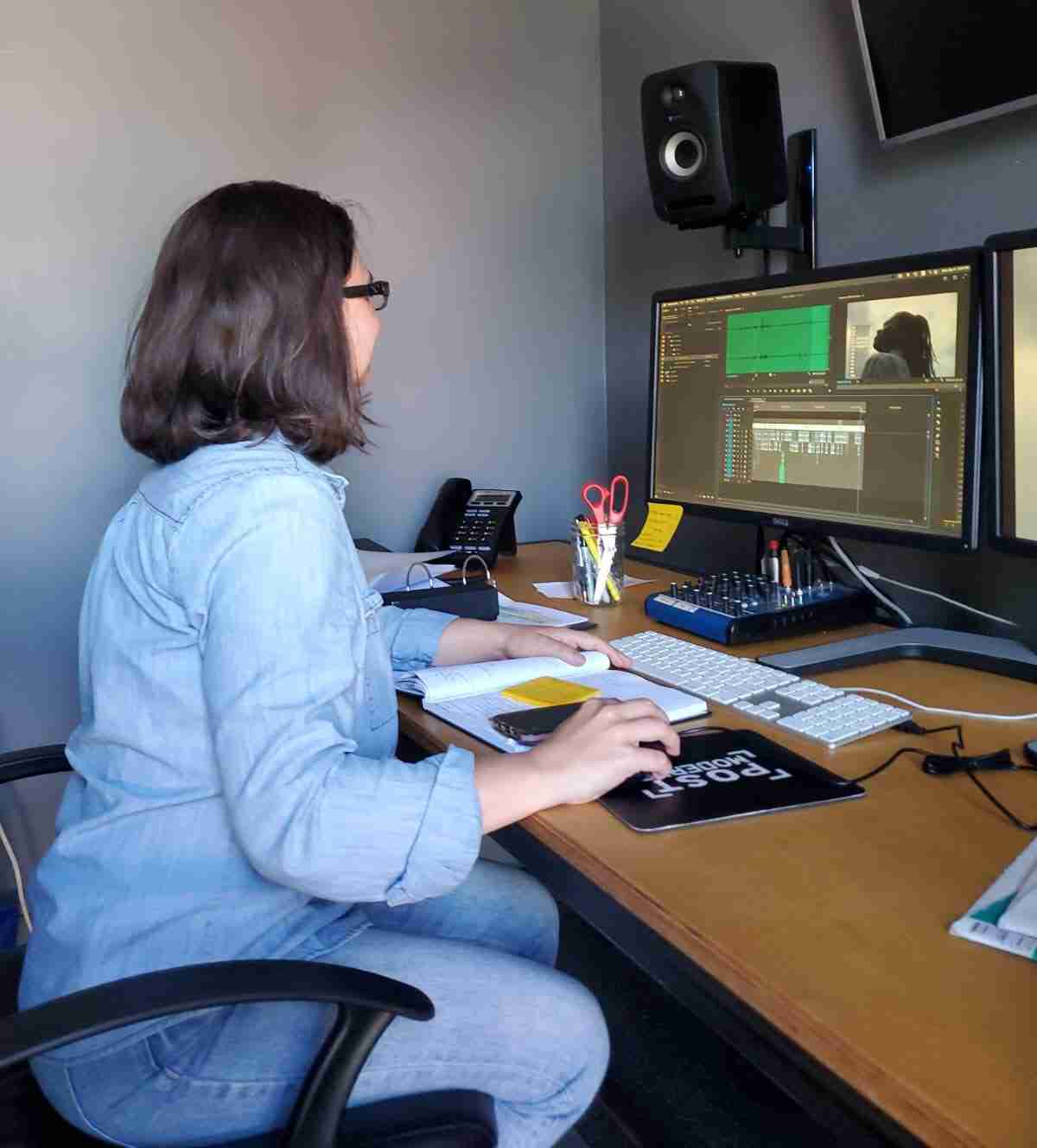
As her assistant editor, I not only worked inside a cubicle, but also participated in the entire post-production and finalization process of each film. This is an immense learning experience, because one is there, from script analysis to theatrical release, seeing the work as a whole and not just in parts.
This gave me another perspective for editing and I applied that knowledge in my own works and short films, such as Camionero (2012), which won me awards and security and allowed me to start building my voice as an editor.
But the curiosity -insatiable, feverish- that animates me did not let pass the opportunity to live another new experience.
An “Editing Assistance Workshop” that I taught for first-year students at the International School of Cinema and Television (EICTV), in the context of the “Film Editing Workshop” taught by Nelson Rodriguez, convinced me that this space, located in San Antonio de los Baños, Cuba, was calling me.
When I got a scholarship to study there, I realized that this is the school where “the utopia of the eye and the ear”, as Fernando Birri called it, becomes a reality.
As soon as you set foot inside, you are shaken by the reception. As if arriving in purgatory, the entrance of the EICTV reminds you, on a daily basis, of the following:
«If an engineer builds a bridge badly, that bridge falls down; if a doctor cures a disease badly, that sick person dies; if a filmmaker, a videomaker, a television director makes a bad film, a bad video, a bad television, apparently nothing happens, nobody dies. Tibetans, Kabbalists, Jean Cocteau repeated: “Distrust mirrors”. What are these audiovisual images if not the most ephemeral of mirrors, the most dangerous of mirrors, a mirror capable of reflecting dreams, capable of evoking on the white of a screen the world universe and making it disappear again in a white nothingness, without even shattering? I ask you eyes, ears. Images can also kill, crumbling secret architectures of the imagination, burying neurons of conscience under the rubble of insensitivity, venality, mediocrity.» (Fernando Birri, 1986).
With this warning, I embarked on a journey in which teachers and professionals from the four corners of the world joined me to share their knowledge.
From Nils Pagh Andersen, when he spoke about The act of killing (2012), I learned not to judge the characters.
With Claude Bailblé, when delving into the rushes of Agnès Varda’s The Gleaners and the Gleaner (2000), I discovered the twenty-odd layers of reading between a filmmaker’s gaze and a close-up.
Unearthing the conflicts behind The Celebration (Thomas Vinterberg, 1998) or The Hours (Stephen Daldry, 2002), I explored the classical narrative with the master Miguel Pérez, director of The Lost Republic (1983).
The most irreverent narratives, on the other hand, came to me through Rosa Teichmann’s Prologue (2004), by Béla Tarr.
Every night, in the Glauber Rocha hall of the EICTV, we enjoyed screenings of the latest international cinema coming into the country. It was a treasure that Jorge Yglesias and his guests would always bring us.
Fernando Valenzuela would make me discover the first cut in the history of cinema.
Miguel Lavandeira would invite me to watch Rashōmon (1950) cut by cut.
Walter Carvalho would encourage me to jump the axis with the most refined wisdom.
Asghar Farhadi would invite me to twist a plot to get what he wanted from an actor.
There were no limits!
It was then that I began to lean towards a more intimate cinema, a cinema that questions the human being, that explores the limits between fiction and documentary. And that growing appreciation for creative documentary led me to discover, within the visible, the invisible.
The International School of Film and Television made my wings grow and, after three years in the editing islands of that wonderful farm, I had the privilege of attending the Berlinale Talent Campus, Guadalajara 2016, and I also won the Emerging Leaders in the Americas Program (ELAP) research grant at Concordia University.
Then came to my days emigration, love, family… and, with them, the need to reinvent myself.
Nothing in front of me was familiar. Neither the language, nor the climate, nor the culture, nor the social and political system… Nothing.
The career that had brought me so much excitement and joy had to wait in a corner of my soul. But, with the seeds under the ground, in winter, I knew that life was dormant, waiting to bloom when the conditions were right.
I clung to Werner Herzog’s words when, in a lecture at EICTV, he told us that we had to do things outside cinema -he was a welder at one point-, that we had to nourish cinema with life and not only with cinema.
I doubted, for a certain period of time, the relevance of making art, but my research on the paths of creativity, inspiration and intuition restored that relevance with new courage and certainty.
This new stage allowed me to cultivate patience, the openness of spirit towards the “other” and it revived an unusual pleasure -latent in me- for transmitting knowledge.
Today I return to Andrei Tarkovsky to deepen my studies on time and the transcendence of images.
Today I walk the world as a freelance editor, thirsting to tell stories that dialogue with the new reality I inhabit. Where does this search lead me? There is no single answer to that question. That direction -for my own pleasure- is decided by each new story.